M101
23 millones de años luz
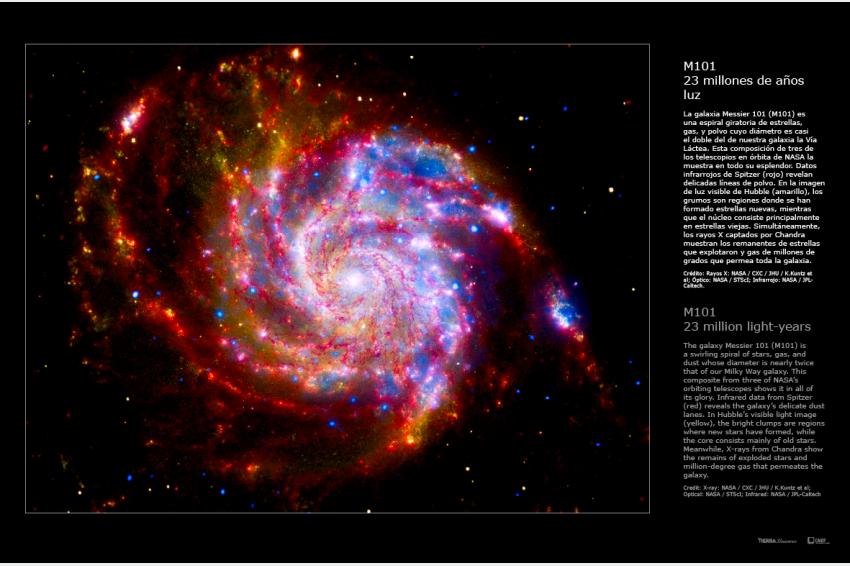
La galaxia Messier 101 (M101) es una espiral giratoria de estrellas, gas, y polvo cuyo diámetro es casi el doble del de nuestra galaxia la Vía Láctea. Esta composición de tres de los telescopios en órbita de NASA la muestra en todo su esplendor. Datos infrarrojos de Spitzer (rojo) revelan delicadas líneas de polvo. En la imagen de luz visible de Hubble (amarillo), los grumos son regiones donde se han formado estrellas nuevas, mientras que el núcleo consiste principalmente en estrellas viejas. Simultáneamente, los rayos X captados por Chandra muestran los remanentes de estrellas que explotaron y gas de millones de grados que permea toda la galaxia.
Crédito: Rayos X: NASA / CXC / JHU / K.Kuntz et al; Óptico: NASA / STScI; Infrarrojo: NASA / JPL- Caltech.
--
M101
23 million light-years
The galaxy Messier 101 (M101) is a swirling spiral of stars, gas, and dust whose diameter is nearly twice that of our Milky Way galaxy. This composite from three of NASA’s orbiting telescopes shows it in all of its glory. Infrared data from Spitzer (red) reveals the galaxy’s delicate dust lanes. In Hubble’s visible light image (yellow), the bright clumps are regions where new stars have formed, while the core consists mainly of old stars. Meanwhile, X-rays from Chandra show the remains of exploded stars and million-degree gas that permeates the galaxy.
Credit: X-ray: NASA / CXC / JHU / K.Kuntz et al; Optical: NASA / STScI; Infrared: NASA / JPL-Caltech.