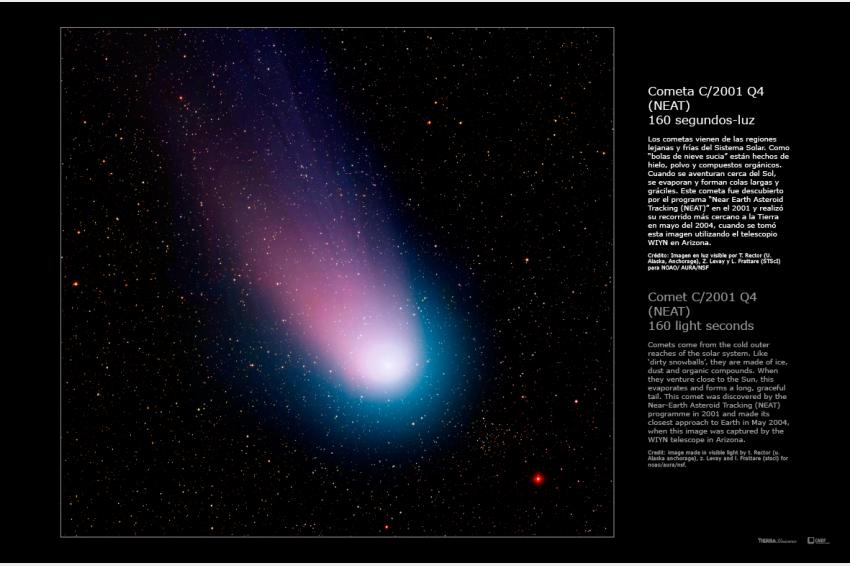
Cometa C/2001 Q4
(NEAT)
160 segundos-luz
Los cometas vienen de las regiones lejanas y frías del Sistema Solar. Como “bolas de nieve sucia” están hechos de hielo, polvo y compuestos orgánicos.
Cuando se aventuran cerca del Sol, se evaporan y forman colas largas y gráciles. Este cometa fue descubierto por el programa “Near Earth Asteroid Tracking (NEAT)” en el 2001 y realizó su recorrido más cercano a la Tierra en mayo del 2004, cuando se tomó
esta imagen utilizando el telescopio WIYN en Arizona.
Crédito: Imagen en luz visible por T. Rector (U.Alaska,Anchorage), Z. Levay y L. Frattare (STScI) para NOAO/ AURA/NSF
--
Comet C/2001 Q4
(NEAT)
160 light seconds
Comets come from the cold outer reaches of the solar system. Like ‘dirty snowballs’, they are made of ice, dust and organic compounds. When they venture close to the Sun, this evaporates and forms a long, graceful tail. This comet was discovered by the
Near-Earth Asteroid Tracking (NEAT) programme in 2001 and made its closest approach to Earth in May 2004, when this image was captured by the WIYN telescope in Arizona.
Credit: image made in visible light by t. Rector (u.Alaska, Anchorage), z. Levay and l. Frattare (stsci) for noao/aura/nsf.