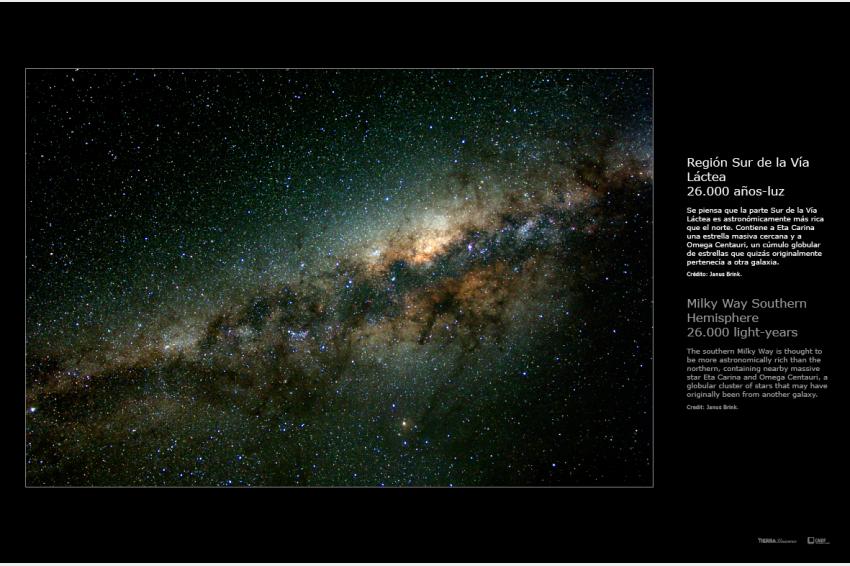
Región Sur de la Vía Láctea
26.000 años-luz
Se piensa que la parte Sur de la Vía Láctea es astronómicamente más rica que el norte. Contiene a Eta Carina una estrella masiva cercana y a Omega Centauri, un cúmulo globular de estrellas que quizás originalmente pertenecía a otra galaxia.
Crédito: Janus Brink.
--
Milky Way Southern Hemisphere
26.000 light-years
The southern Milky Way is thought to be more astronomically rich than the northern, containing nearby massive star Eta Carina and Omega Centauri, a globular cluster of stars that may have originally been from another galaxy.
Credit: Janus Brink.